
Stand on a rocky shore and the cliffs can look finished, as if the land had always worn that shape. In the late eighteenth century, a different reading of those rocks began to take hold. James Hutton argued that the Earth is not a static stage set once and for all, but a machine of slow cycles: erosion wearing mountains down, sediments settling into new beds, heat and pressure raising land again. The implication was radical. If everyday processes can remake continents, then the planet's history is not a short drama. It is deep time - a span so large that a human lifetime is barely a grain of sand on the beach.
Hutton was born in Edinburgh in 1726. He studied medicine, managed farms in the Borders, and moved easily among the experimental and philosophical circles of the Scottish Enlightenment. That mix mattered. As a farmer he watched soil wash away and sediments collect. As a natural philosopher he asked what those ordinary processes meant when they ran without pause. The result was not a romantic sketch of scenery. It was a theory of how rock, heat, water, and time collaborate to rebuild the world.

In 1785 he presented the core of his argument to the Royal Society of Edinburgh. A fuller version appeared in the Society's Transactions in 1788, and Hutton expanded the work into a two-volume book in 1795. Later geologists would summarize this approach as using the present to interpret the past. Rivers cut valleys today; similar rivers, he reasoned, cut valleys in the past. Sediment settles in lakes and seas today; older layered rocks record the same kind of settling. Heat softens and transforms materials in furnaces and volcanoes; subterranean heat, he argued, helps form new rock and lift land from below. The point was not that every ancient event must look identical to a modern one. It was that the same kinds of natural causes, working over immense intervals, can explain the features we see without inventing a separate physics for the past.
That stance set him against a common picture of Earth history as a short sequence of sudden, world-remaking catastrophes. Hutton did not deny that dramatic events occur. He insisted that gradual processes are powerful enough, given time, to account for vast change. Mountains are worn down grain by grain. Seas fill with mud and sand. Rock can be folded, tilted, and later capped by newer beds. If those steps are real, the calendar of the planet expands far beyond any chronology built only from human memory or recent tradition.
Evidence, not eloquence alone, made the case memorable. Hutton searched for places where rock layers told a story of interruption and renewal. At Jedburgh he found older beds standing nearly on end, with younger strata resting above them at a different angle - an unconformity, a boundary that records missing time and a change in the Earth's surface before deposition resumed. The most famous demonstration came in 1788, when Hutton sailed the Berwickshire coast with John Playfair and Sir James Hall and reached Siccar Point.
At Siccar Point, nearly vertical greywacke sandstones and mudstones of early Silurian age meet younger, gently inclined red Upper Devonian sandstone and breccia above them. The contact is sharp enough to read at a glance. The lower rocks had to be laid down as sediments, hardened, folded until their layers stood upright, lifted, and worn away into an ancient land surface. Only then could the red beds settle across that eroded edge. Between the two packages of rock lies not a thin crack but a long absence in the local record - a gap spanning many millions of years. Hutton did not have modern radiometric ages. He had geometry, process, and the stubborn fact that slow work repeated is still work completed.
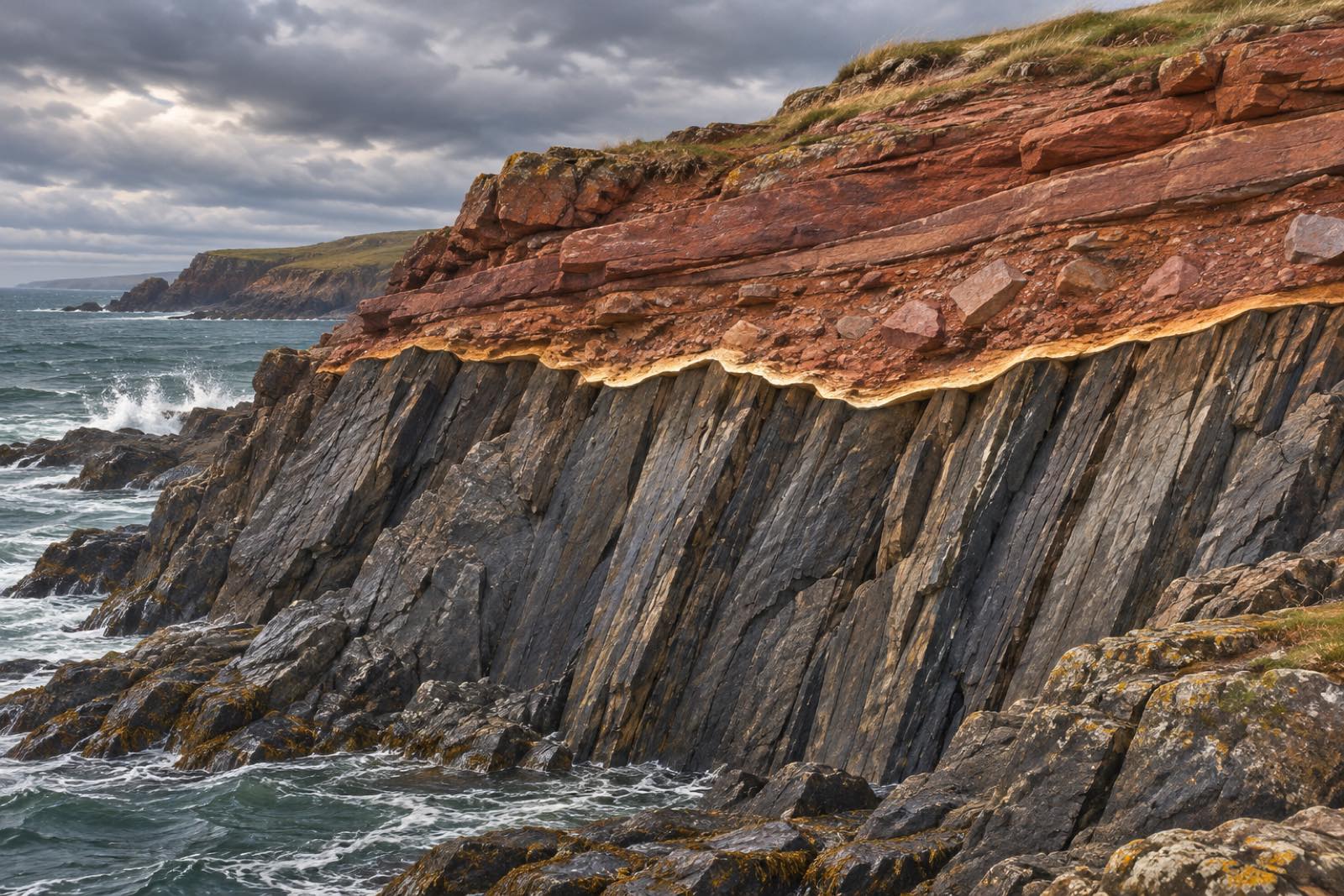
John Playfair later wrote that the mind seemed to grow giddy looking so far into the abyss of time. The phrase has become a kind of motto for the site, and for good reason. An unconformity is easy to miss if one treats every cliff as a single frozen moment. Once the junction is seen as a buried landscape, the cliff becomes a clock with most of its hours erased. What remains is still enough to show that Earth had already lived through cycles of ocean, mountain building, erosion, and new deposition long before the present coastline existed.
Hutton's theory also leaned on internal heat. He argued that subterranean fire and pressure help consolidate sediments and raise land, balancing the endless loss of material to the sea. He studied junctions where granite and other crystalline rocks cut across older beds, reading them as evidence that molten or plastic material had invaded from below. Later laboratory work by Hall and others tested pieces of this picture. Not every detail of Hutton's mechanism matches modern plate tectonics or modern petrology. The larger move remains sound: the solid Earth is an active engine, and surface form is the temporary product of processes that continue.
Reception was mixed, and that history is part of the lesson. Hutton's prose could be dense. Some readers preferred catastrophic stories that kept Earth young and events rare but total. Playfair's clearer restatement in Illustrations of the Huttonian Theory of the Earth (1802) helped carry the ideas forward. In the nineteenth century, Charles Lyell developed uniformitarian reasoning into a systematic program of geological interpretation. Still later, absolute dating methods assigned numbers to the relative sequences Hutton and his successors had ordered by structure and fossils. Deep time became measurable, not only imaginable.
Modern geology keeps the spirit of the insight while refining its limits. Processes observed today are a powerful guide to the past, yet rates can change, and rare events can leave outsized marks. Ice ages, asteroid impacts, and mass extinctions belong in the full inventory. Uniformitarianism, properly understood, is not a claim that nothing dramatic ever happened. It is a demand that explanations stay tied to natural causes that can be investigated, compared, and tested against the rock record. Hutton opened that door by refusing to treat the landscape as a finished prop.
There is also a quieter methodological gift in his work. He crossed the borders between farming, chemistry, medicine, and field observation. He treated a coastal outcrop as an experiment already run by nature, waiting to be read. Siccar Point did not hand him a written date. It handed him a sequence that any careful observer could check: vertical beds, eroded top, younger cover. From that sequence he inferred duration. Science often advances this way - by finding a place where the world has left a readable joint between chapters.
For researchers and students today, the inspiration is practical. Look for the junction that does not fit a simple story. Ask what processes, repeated or interrupted, could build that geometry. Welcome the dizzy feeling that comes when a familiar cliff suddenly implies millions of years. Hutton's courage was not the claim that he had finished Earth's history. It was the willingness to let evidence force the calendar open, and to trust that slow causes, honestly followed, can explain a restless planet.
Walk away from Siccar Point with that habit of mind and the ground under any city feels different. Hills are temporary. Seabeds become stone. Stone becomes soil again. The Earth keeps rewriting itself, and the record is incomplete on purpose - full of gaps that are themselves clues. Hutton helped turn those gaps from embarrassments into evidence. In doing so he gave geology its characteristic ambition: to recover a past far longer than our own, using only what the present still allows us to see, measure, and understand.