
Many systems that matter to science are neither tidy grids nor pure chaos. A brain is not a lattice of nearest neighbors alone. A power grid is not a bag of random wires. A circle of acquaintances is not a complete free-for-all. Between order and randomness sits a middle structure that feels familiar in daily life and, until the late 1990s, was surprisingly hard to model with mathematical honesty: a world that is tightly clustered locally, yet only a few hops across globally.
On 4 June 1998, Duncan J. Watts and Steven H. Strogatz published a short Nature paper titled "Collective dynamics of 'small-world' networks." Working from Cornell's Department of Theoretical and Applied Mechanics, they offered a simple generative idea with large consequences. Start with a regular ring lattice, where each node connects only to nearby neighbors. Then rewire a fraction of those edges at random. Even a tiny rewiring probability can collapse the average distance between nodes almost to the level of a random graph, while the local clustering coefficient stays nearly as high as in the original lattice. The resulting graphs are small-world networks: highly clustered, yet short in characteristic path length, by analogy with the popular "six degrees of separation" idea.
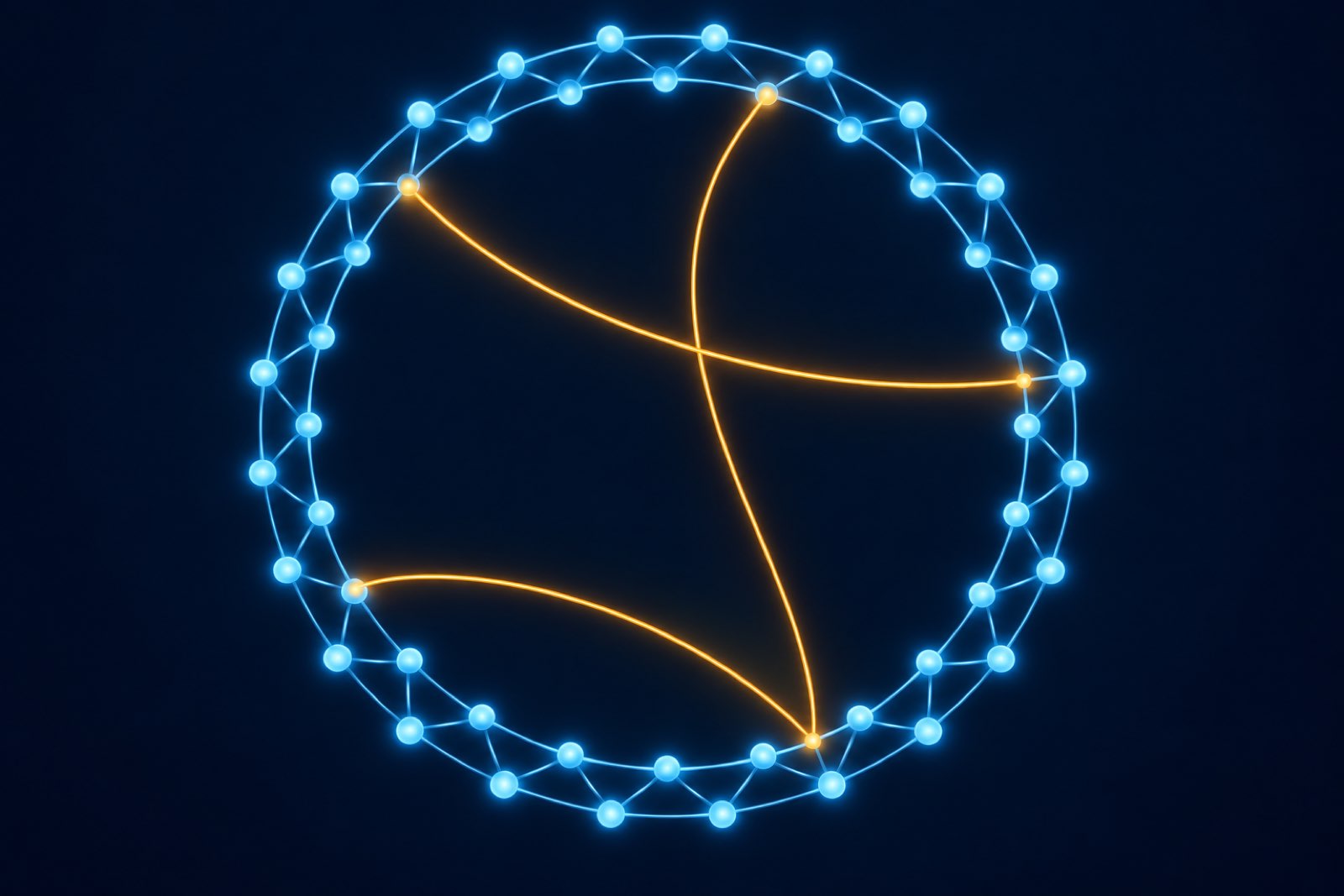
The paper's power begins with the clarity of its contrast. On one side stand regular lattices. They excel at local order. Neighbors of a node tend to be neighbors of one another, so the clustering coefficient is high. The cost is distance. To reach a far side of a large lattice, a signal must hop many times. On the other side stand classical random graphs in the spirit of Erdős and Rényi. Average path lengths are short, because random long-range links appear early. Clustering, however, is low. Friendship circles do not form the way they do in real social life. Real systems seemed to live between those extremes, yet the mathematical toolkit often forced a choice between them.
Watts and Strogatz refused the false choice. Their construction keeps the ring's local fabric and sprinkles disorder through controlled rewiring. For each edge, with probability p, one end is moved to a randomly chosen node, avoiding self-loops and duplicate edges. When p equals zero, the network is the original lattice. When p equals one, the network is essentially random. The intellectually interesting regime is small but nonzero p. There, average path length L falls steeply toward the random-graph baseline, while clustering C remains close to its lattice value for a wide window. A few shortcuts do disproportionate work. Removing one local edge to create a long-range bridge changes clustering only linearly, but it can cut many global routes at once.
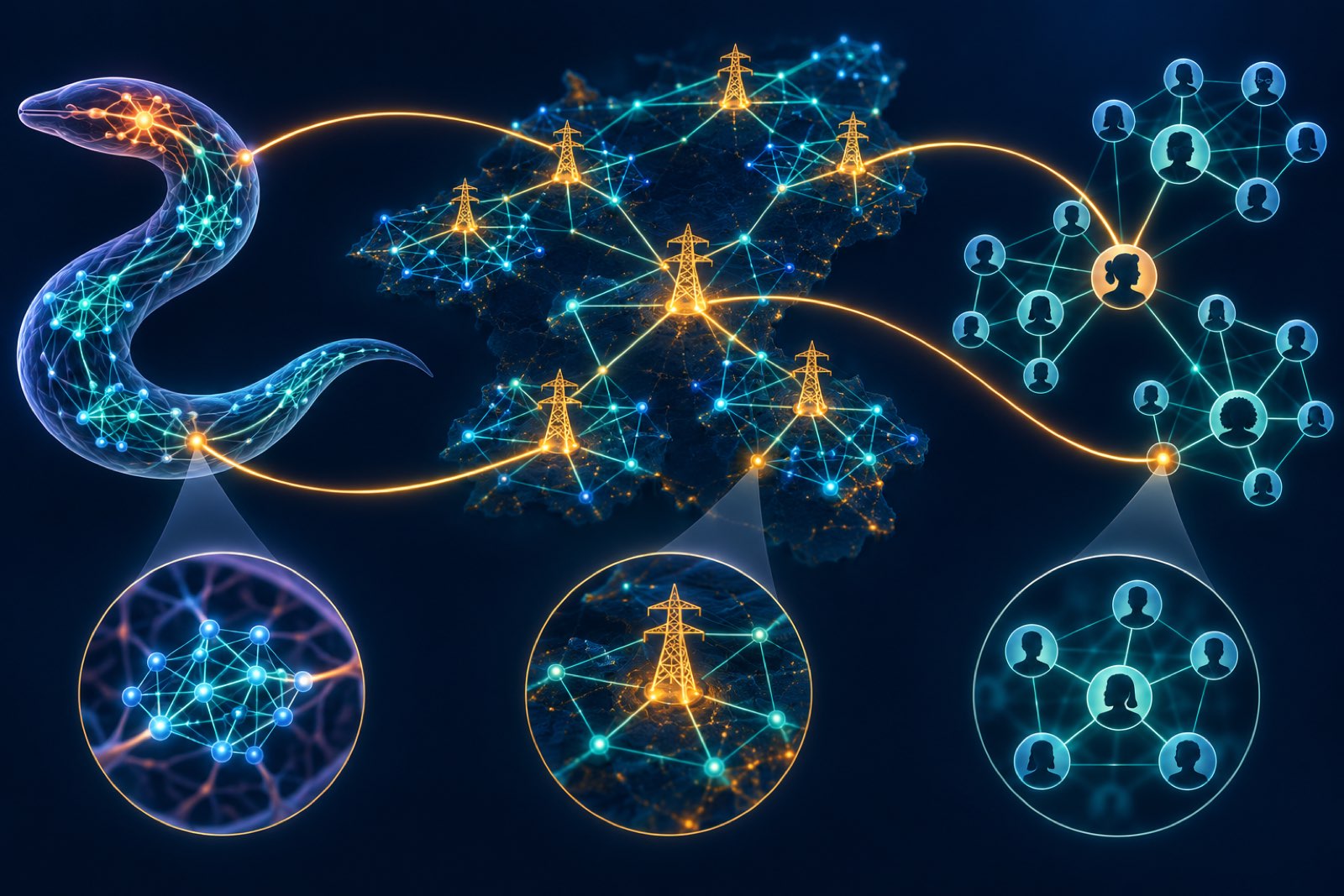
That asymmetry is the conceptual heart of the result. Globally, the network becomes a small world almost immediately. Locally, the transition can be almost invisible. Communities, neighborhoods, and modules can remain dense even as the diameter of the whole system shrinks. The model therefore explains a feeling many people already have about social life: your friends know one another, yet a short chain of introductions can still reach a stranger far away. The same geometry appears outside sociology. The collaboration graph of film actors, the neural network of the nematode worm Caenorhabditis elegans, and the power grid of the western United States were presented in the paper as empirical small-world examples. Different domains, similar statistics.
Dynamics make the geometry consequential. Watts and Strogatz argued that small-world coupling can enhance signal-propagation speed, computational power, and synchronizability relative to purely local coupling. Infectious disease models offered a concrete illustration. In their simulations, the infectiousness needed to infect half a population dropped quickly once a few long-range contacts appeared. For a disease already infectious enough to reach everyone eventually, the time to global infection tracked the shortened path length. In plain language, clustered contact alone can slow a spread; a handful of bridges can accelerate it dramatically. The lesson is not that every epidemic is a small-world epidemic. It is that contact structure is not a decorative detail. Topology can dominate timelines.
The interdisciplinary reach of the idea expanded almost immediately. Neuroscientists recognized that brains combine dense local circuits with long-range white-matter projections. Ecologists and epidemiologists saw metapopulations linked by rare long-distance dispersal. Engineers saw communication networks, sensor webs, and infrastructure grids that mix neighborhood redundancy with occasional trunk links. Economists and organizational theorists saw firms, markets, and knowledge communities that cluster by specialty while still transmitting ideas through sparse brokers. The model did not claim that every network is Watts-Strogatz. It claimed that a previously awkward pair of properties - high clustering and short paths - can arise from one transparent mechanism, and that many real systems sit near that compromise.
A year later, another landmark widened the map again. In 1999, Albert-László Barabási and Réka Albert showed in Science that many large networks also display heavy-tailed degree distributions: a few hubs collect a disproportionate share of links. Their growth-and-preferential-attachment mechanism is different from ring rewiring, and the resulting scale-free structure is not identical to a small world. The two ideas became complementary pillars of modern network science rather than rivals. Small-world models emphasize how shortcuts reshape distance and clustering. Scale-free models emphasize how inequality of connectivity emerges and why hubs matter for robustness and attack. Together they helped shift research from abstract graphs toward measured architecture in living, technical, and social systems.
What made the 1998 result travel so well was its measurement discipline. Clustering is not a mood. It is a local density statistic: how often two neighbors of a node are also linked to each other. Characteristic path length is not a slogan about fame. It is an average distance over pairs of nodes. Once those quantities are defined, a model can be compared with data instead of with anecdote. Researchers could ask whether a power grid, a metabolic graph, or a collaboration network was "small-world-like" in a falsifiable sense: high C relative to a random baseline, low L relative to a lattice baseline. That comparative habit helped network science mature from metaphor into a shared toolkit used by physicists, biologists, computer scientists, and social scientists who previously spoke past one another.
The same discipline also clarified design trade-offs. In a communication system, pure locality can protect neighborhoods and reduce wiring cost, yet it can make global coordination slow. Pure randomness can shrink distances, yet it can destroy modular structure that supports specialization, fault isolation, or community trust. A small-world compromise suggests that a modest budget of long-range links, placed carefully, can buy most of the global speed while keeping most of the local fabric. Engineers still must choose capacities, latencies, and failure modes. Biologists still must respect development and energy cost. The conceptual map, however, is clearer: do not optimize only clustering or only diameter. Optimize the joint geometry that real systems actually use.
None of this erased hard limits. The original Watts-Strogatz construction is deliberately simple. Real edges are not always rewired independently. Real degree distributions are often far from regular. Spatial embedding, directed links, multiplex layers, community structure, and temporal change all matter. A social platform is not a nematode nervous system, even if both can show short paths and high clustering. Epidemic forecasts need contact data, behavioral response, and incubation biology, not only a path-length curve. Infrastructure resilience depends on capacities, cascading failure rules, and repair logistics. Treating "small world" as a slogan rather than a measurable pair of statistics invites overclaim. The scientific value of the model is precision under idealization, not magic universality.
Even so, the intellectual bargain remains strong. Before 1998, it was easy to talk loosely about six degrees of separation and hard to put the phenomenon on a controllable continuum between order and randomness. Watts and Strogatz gave researchers a dial, p, and two observables, L and C, that could be tracked together. They showed that the interesting regime is not the midpoint of intuition but a thin band near order, where a little disorder does a lot of global work. That is a classic interdisciplinary gift: a mechanism simple enough to teach, rich enough to travel, and honest enough to admit what it does not yet capture.
For today's researchers, the small-world story is less a closed chapter than a standing invitation. Whenever a system looks modular yet fast, local yet global, clustered yet permeable, the right question is structural. Where are the shortcuts? How many are needed? What happens if they fail, if they multiply, or if they concentrate on a few hubs? Those questions cut across genomics interaction maps, climate teleconnections, logistics corridors, scientific citation webs, and artificial neural architectures. They reward people willing to measure topology instead of assuming it, and willing to borrow tools from mechanics, graph theory, biology, and the social sciences without apology.
The deeper lesson is creative as much as technical. Watts and Strogatz did not invent complexity from exotic machinery. They started with a ring everyone could draw, added a probability everyone could understand, and watched a familiar social metaphor become a quantitative object. That move - refusing the false choice between pure regularity and pure randomness - is exactly the kind of boundary-crossing habit modern science needs. When a field feels stuck between two incomplete idealizations, the productive act is often to build the missing middle with enough clarity that other disciplines can test it on their own data.
Explore the evidence: