
A voice crosses an ocean. A photograph arrives on a screen. A few lines of text travel through a world of wires, radio waves, and interference, yet reach us recognizably intact. Behind these familiar moments lies a question that once challenged the foundations of communication: what, exactly, must survive the journey? In 1948, Claude Shannon gave that question a mathematical form. His paper, “A Mathematical Theory of Communication,” revealed a common structure beneath messages that seemed to have little in common. Words, music, and images could all be studied through the uncertainty they resolved. That insight helped lay the foundations of our digital world.
At Bell Telephone Laboratories, communication was a practical concern. Engineers needed to carry more conversations over crowded lines and recover signals disturbed by noise. Shannon looked beyond the individual devices to ask what all these systems shared. Building on earlier work by Harry Nyquist and Ralph Hartley, he imagined communication as a relationship between a source, a channel, and a receiver. What could be learned by setting aside the machinery for a moment and examining the message itself?

Imagine a coin that always lands heads. Before it falls, you already know the result. Now imagine a fair coin. Each toss leaves a question open until you see the outcome. Shannon’s idea of information begins with that difference: how much uncertainty does a message remove? An unexpected symbol carries more information than one we could confidently predict. He called the average uncertainty of a source its entropy. Measured in bits, it helps reveal how far a message can be compressed without losing anything. When symbols depend on one another, as letters do in language, those patterns matter too. What looks like a long message may contain less new information than its length suggests.
Noise introduces another puzzle. If a channel sometimes changes what we send, must every message remain vulnerable to misunderstanding? Shannon showed that carefully designed codes could make errors arbitrarily unlikely, provided the information rate stayed below the channel’s capacity and the codes were sufficiently long. The details depend on the channel being modeled, but the insight is striking: noise need not make reliable communication impossible. There is a boundary to what a channel can carry, and there are ways to approach it. His theorem established that possibility without handing engineers a finished code.
That result gave practical invention a new direction. Engineers could ask how close a design came to the theoretical limit, rather than simply whether it improved on the previous machine. Convolutional, turbo, and low-density parity-check codes belong to this continuing search. Their names may be unfamiliar, but the ambition behind them is part of everyday life: helping a message arrive faithfully despite an imperfect journey.
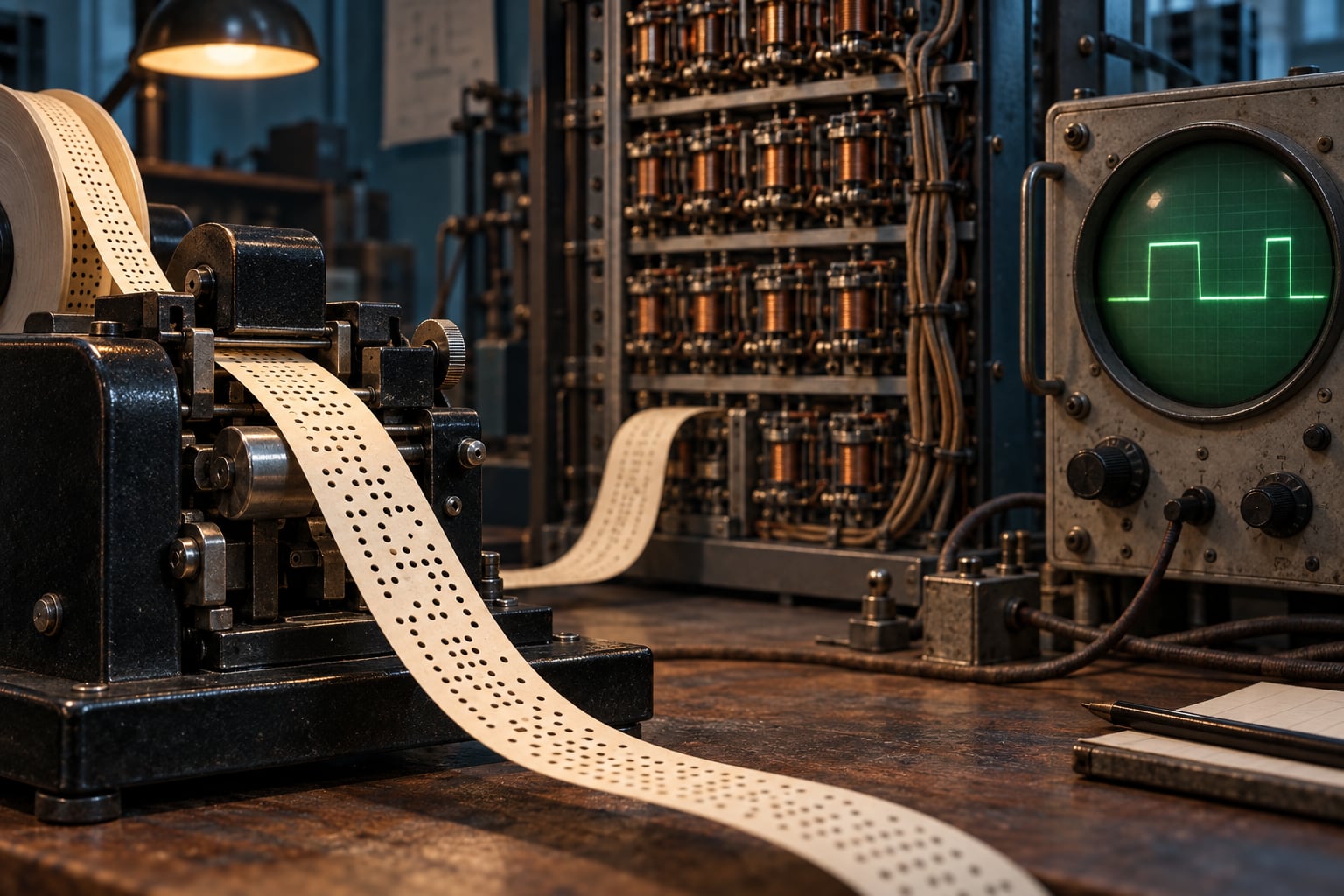
The unit mattered too. Shannon credited John Tukey with the word “bit,” short for binary digit. By measuring information in bits, he gave disparate technologies a common currency. A punched card, a radio pulse, a magnetic domain, and a voltage level could all be counted in the same units. That common measure made it possible to compare media, to budget bandwidth, and eventually to design digital systems in which content is indifferent to the physics underneath - so long as the physics delivers bits at a known rate with a known error probability. The modern stack of layers in networking is, in spirit, an engineering elaboration of Shannon’s separation between message and medium.
Shannon’s career prepared him unusually well for this synthesis. Born in 1916 in Michigan, he studied electrical engineering and mathematics at the University of Michigan and completed a celebrated master’s thesis at MIT that showed how Boolean algebra could describe relay switching circuits. That earlier work already revealed his habit of translating messy engineering practice into clean mathematical structure. At Bell Labs during and after the Second World War he worked on secrecy systems and fire-control problems, experiences that sharpened his sense of what it means to protect a message and what it costs to recover one from noise. The 1948 paper gathered those threads into a single framework that colleagues immediately recognized as foundational.
There is a subtle distinction at the heart of this theory. A message can be surprising without being meaningful. A sequence of random letters may be difficult to predict, while a familiar sentence may tell us something deeply important. Shannon’s measure addresses uncertainty, not human significance. He set meaning aside so that the problem of transmitting symbols could be studied clearly. That choice invites a broader question: how much can we discover by choosing carefully which part of a problem to examine? His theory does not settle what makes a message valuable, and practical systems must still contend with delay, computing costs, and changing conditions. Its power comes partly from knowing where its questions begin and end.
Even with those limits, the reach of the framework has been extraordinary. Information theory connected statistical inference with measures of uncertainty, while rate-distortion theory quantified the trade-off between compression and acceptable loss. It informed the design of hard drives, optical discs, and cellular standards. Cryptography absorbed Shannon’s notion of perfect secrecy and the insight that a secret’s strength can be discussed in bits of uncertainty. Biology later borrowed informational language for genetic codes and neural signaling, sometimes carefully and sometimes metaphorically. Physics found deep analogies between informational entropy and thermodynamic entropy, a conversation that continues in work on Maxwell’s demon, Landauer’s principle, and quantum information. Few twentieth-century papers have seeded so many disciplines while remaining readable as a piece of pure engineering mathematics.
Shannon’s achievement is especially revealing as a way of thinking. He saw connections across mathematics and engineering, then followed them far enough to make something previously elusive measurable. The physical differences between a telephone conversation and a printed message were obvious. Finding what they shared required imagination. His abstraction gave later inventors room to explore, with a clearer understanding of the possibilities before them.
For today’s researchers, that approach offers an invitation. When a problem seems crowded with details, what might become visible if we looked for the relationships beneath them? Which uncertainties matter, and which familiar assumptions deserve another look? Experiments and prototypes can help answer those questions, just as theory can suggest what to try next. Shannon’s example encourages curiosity across disciplines and a willingness to give an ordinary question sustained attention.
The next time a voice reaches you through a noisy connection, consider the quiet achievement behind it. Something has been preserved across distance, interference, and changing physical forms. Shannon helped us understand how that could happen. His legacy lives in the systems we use, but also in the habit of looking beneath the familiar and asking what we have yet to understand. A different view of an everyday problem can open an entire field of discovery.