
In the late nineteenth century, light was thought to need a medium the way sound needs air. Physicists called that medium the luminiferous aether and imagined it filling all of space, stiff enough to carry electromagnetic waves at hundreds of thousands of kilometers per second and yet somehow offering no resistance to the planets. If Earth moved through that invisible ocean, then the speed of light measured along the direction of motion should differ from the speed measured at right angles to it. A single laboratory measurement capable of detecting that difference would map our motion through absolute space. When the most careful attempt failed, it did not merely disappoint an experimental program. It removed one of the last pillars of classical mechanics and forced physics to rebuild its notions of space, time, and simultaneity.
The intellectual setting was Maxwell's electromagnetism. James Clerk Maxwell had shown that light is an electromagnetic wave whose speed in vacuum is fixed by electric and magnetic constants. Waves, in the classical imagination, propagate through something. Water waves need water; sound needs air or solids. So light, the argument ran, must need aether. Earth orbits the Sun at roughly thirty kilometers per second. Relative to a supposedly fixed aether, that orbital motion should produce a detectable "aether wind," a tiny anisotropy in the measured speed of light depending on orientation. The effect was expected to be second order in the ratio of Earth's speed to the speed of light - on the order of one part in a hundred million - but optical interferometry had already become sensitive enough, in principle, to see it.
Albert A. Michelson designed an instrument equal to that challenge. His interferometer split a beam of light into two perpendicular paths of nearly equal length, reflected each beam from a mirror, and recombined them so that their interference fringes became a precise readout of path difference. Any change in the optical path along one arm relative to the other would shift the fringe pattern. Mount the apparatus so that one arm could be aligned with Earth's supposed motion through the aether and the other arm perpendicular to it, then rotate the whole table. If the aether wind existed, the fringe pattern should oscillate with a calculable amplitude as the arms swapped roles. Michelson first tried the method in Potsdam in 1881. The result was null within his then-available precision, but the experiment was criticized and the margins were thin. He returned to the problem with Edward W. Morley at Case School of Applied Science in Cleveland.
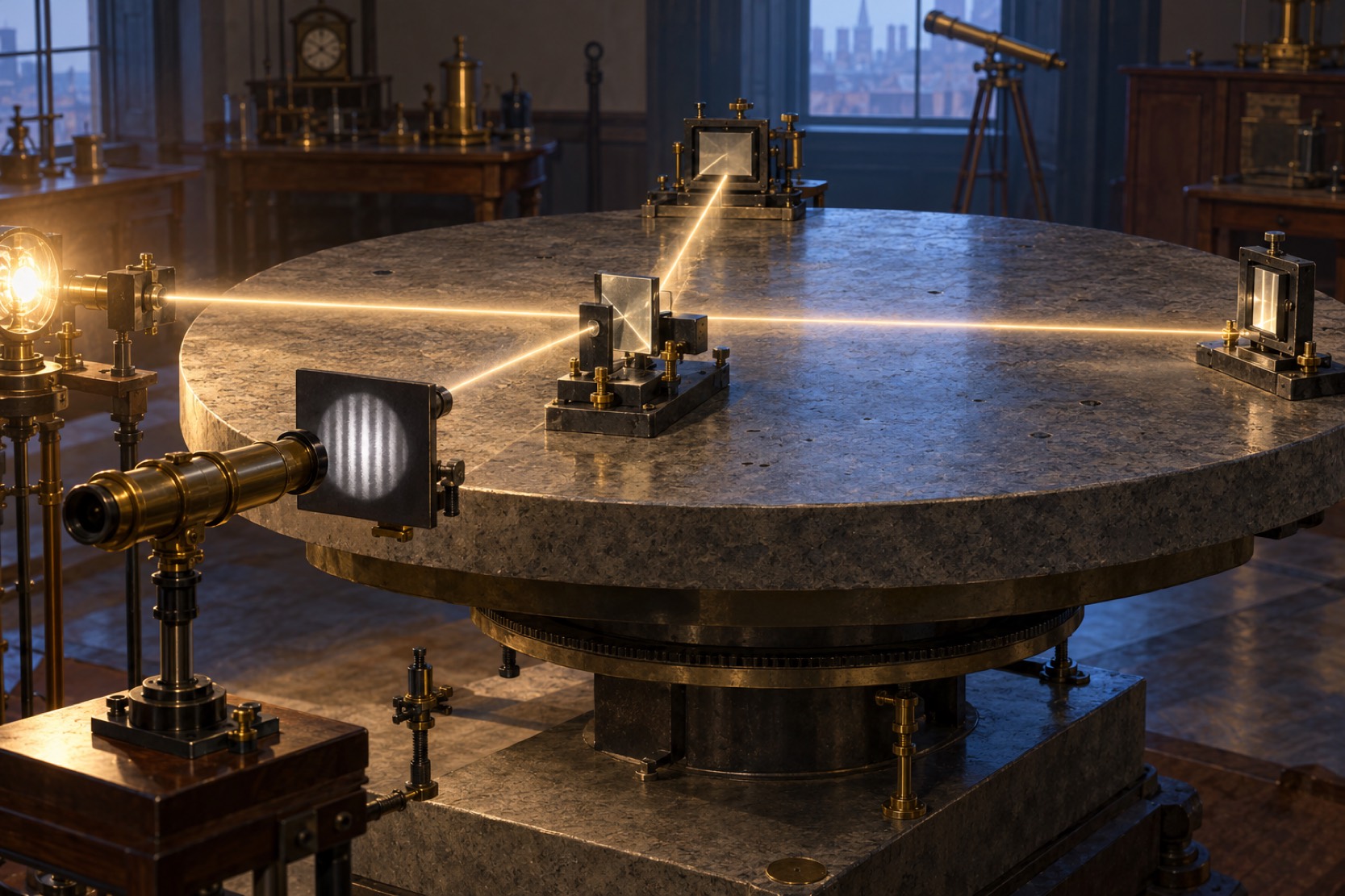
The 1887 Cleveland apparatus remains one of the landmarks of experimental craft. The optical paths were lengthened by multiple reflections so that the expected fringe shift would be large enough to measure confidently. The entire interferometer floated on a massive stone slab suspended in a pool of mercury, damping vibration and allowing smooth rotation through a full circle. Temperature was controlled; the observers watched fringes through a telescope and recorded positions at many orientations. Theory predicted a clear sinusoidal variation with angle if Earth dragged through a stationary aether. What Michelson and Morley found, after repeated runs, was a shift far smaller than the prediction - consistent with zero within experimental error. There was no detectable aether wind.
A null result is not emptiness. It is a hard constraint on every theory that requires the missing effect. Several responses followed. Some physicists proposed that Earth drags the aether locally, so that near the surface the medium moves with the planet and the wind vanishes. Others, notably George FitzGerald and Hendrik Lorentz, suggested that lengths contract along the direction of motion through the aether by exactly the factor needed to cancel the expected optical difference. Lorentz developed a detailed electron theory in which moving charges and fields transform in ways that make the aether effectively undetectable by electromagnetic experiments. Those contractions and local-time transformations were originally patches meant to save the aether. They later became the mathematical skeleton of a deeper revision.
In 1905 Albert Einstein cut the knot differently. Special relativity discarded the aether as unnecessary and elevated two postulates: the laws of physics are the same in all inertial frames, and the speed of light in vacuum is the same for all inertial observers regardless of the motion of the source. From those assumptions follow time dilation, length contraction, and the relativity of simultaneity - without any invisible medium. The Michelson - Morley null result is then not a puzzle requiring a dynamical conspiracy in the aether; it is consistent with light having a single invariant speed. The Lorentz transformations cease to be ad hoc corrections and become the coordinate relations between inertial frames. An experiment designed to measure Earth's absolute velocity had instead helped demonstrate that absolute velocity of that kind is not a meaningful feature of electromagnetic physics.
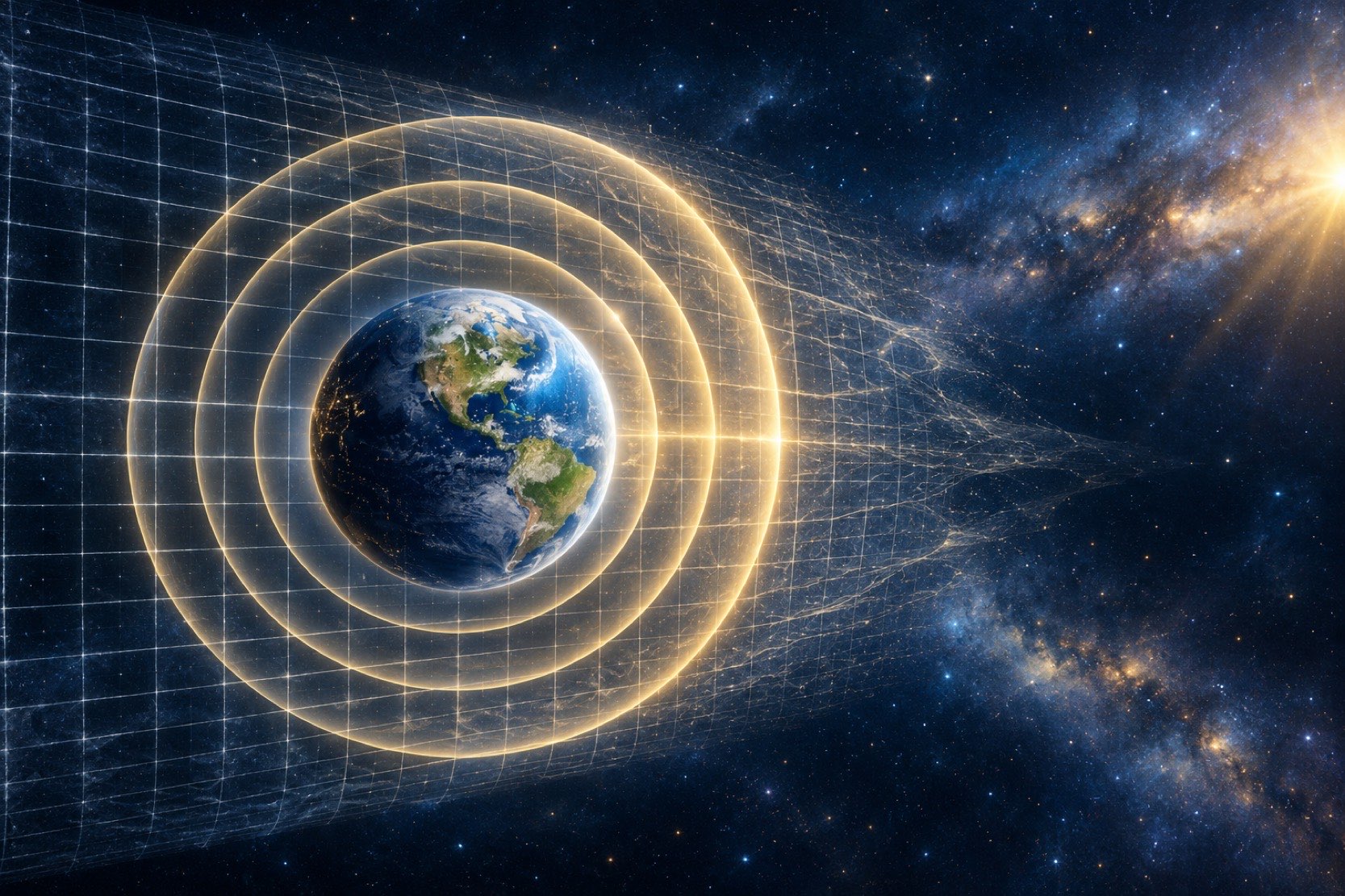
The experimental story did not end in 1887. Later repetitions improved sensitivity by orders of magnitude, using lasers, cryogenic cavities, and optical resonators. Modern tests constrain any anisotropy in the speed of light to fantastically small levels and continue to support Lorentz invariance under conditions Michelson could not have imagined. The original apparatus, preserved and celebrated, is remembered less for what it failed to find than for what that failure made impossible to keep believing. Absolute rest defined by a luminiferous medium did not survive contact with precision optics.
There is a methodological lesson that outlives the particular theory under test. Michelson and Morley did not set out to dethrone Newtonian absolute space. They set out to measure a predicted effect with enough care that a positive detection would be persuasive. When the effect refused to appear, the community faced a choice: lower the standards of evidence, invent increasingly elaborate epicycles for the aether, or allow foundational assumptions to change. The productive path was the third. Null results only become transformative when experimenters refuse to paper over them and theorists are willing to rebuild the conceptual frame that made the missing signal seem mandatory.
That same discipline is still the difference between routine measurement and discovery. Today's searches for dark matter interactions, deviations from inverse-square gravity, preferred frames in high-energy astrophysics, or tiny violations of Lorentz symmetry are Michelson - Morley experiments in new clothing. They ask whether nature respects a symmetry that current theory treats as exact. A null result at higher precision is not failure; it is a sharper boundary on what any successor theory may claim. A positive result, if it ever comes and survives scrutiny, would force the same kind of reconstruction that the aether's disappearance once forced.
The Michelson - Morley experiment also models how craft and concept travel together. Without mercury bearings, long folded optical paths, and obsessive attention to thermal drift, the predicted fringe shift would have been lost in noise and the aether might have lingered for another generation. Without Maxwell's wave theory, there would have been no quantitative prediction to kill. Progress required both the instrument and the idea it was built to test. Researchers who treat apparatus as a mere afterthought to theory, or theory as decoration on instrumentation, miss the coupling that actually moves a field.
What remains inspiring is the integrity of following an observation wherever it leads. The aether was not a fringe speculation; it was mainstream furniture of nineteenth-century physics. Letting it go meant accepting that empty space could sustain light without a mechanical substrate and that "at rest with respect to the universe" is not a privileged laboratory condition. Every generation inherits its own furniture of that kind - assumptions so familiar they feel like facts. The habit worth cultivating is the one Michelson practiced at the eyepiece and Einstein practiced at the desk: design the test so that nature can answer no, and when nature answers no, revise the picture rather than the data. Creativity in science is not the freedom to invent any story; it is the courage to discard a beautiful story that the fringes will not support, and to build a clearer one in its place.
Explore the evidence
- American Institute of Physics - historical profile of Albert A. Michelson and precision optics
- American Physical Society News - Physics History feature related to Michelson-era optical measurement
- Stanford Encyclopedia of Philosophy - inertial frames, relativity, and the conceptual setting after the aether
- Nobel Prize official biographical page for Albert A. Michelson (1907 Physics)