
Chemistry has always been skilled at making molecules. It has been less skilled at placing those molecules into open, permanent rooms where other chemicals can move, bind, react, and leave again. Ordinary crystals pack tightly. Many porous solids are useful but hard to redesign once nature or chance has fixed their structure. The modern question is sharper: can chemists build empty space on purpose, with the same confidence they once reserved for making a single compound?
Metal-organic frameworks answer that question with a kind of molecular architecture. Metal ions or metal-containing clusters act as cornerstones. Long organic molecules act as linkers. Together they assemble into crystalline networks filled with cavities large enough for gases and other small chemicals to flow through. The Royal Swedish Academy of Sciences awarded the 2025 Nobel Prize in Chemistry to Susumu Kitagawa, Richard Robson, and Omar M. Yaghi for the development of metal-organic frameworks, recognizing materials that create rooms for chemistry.
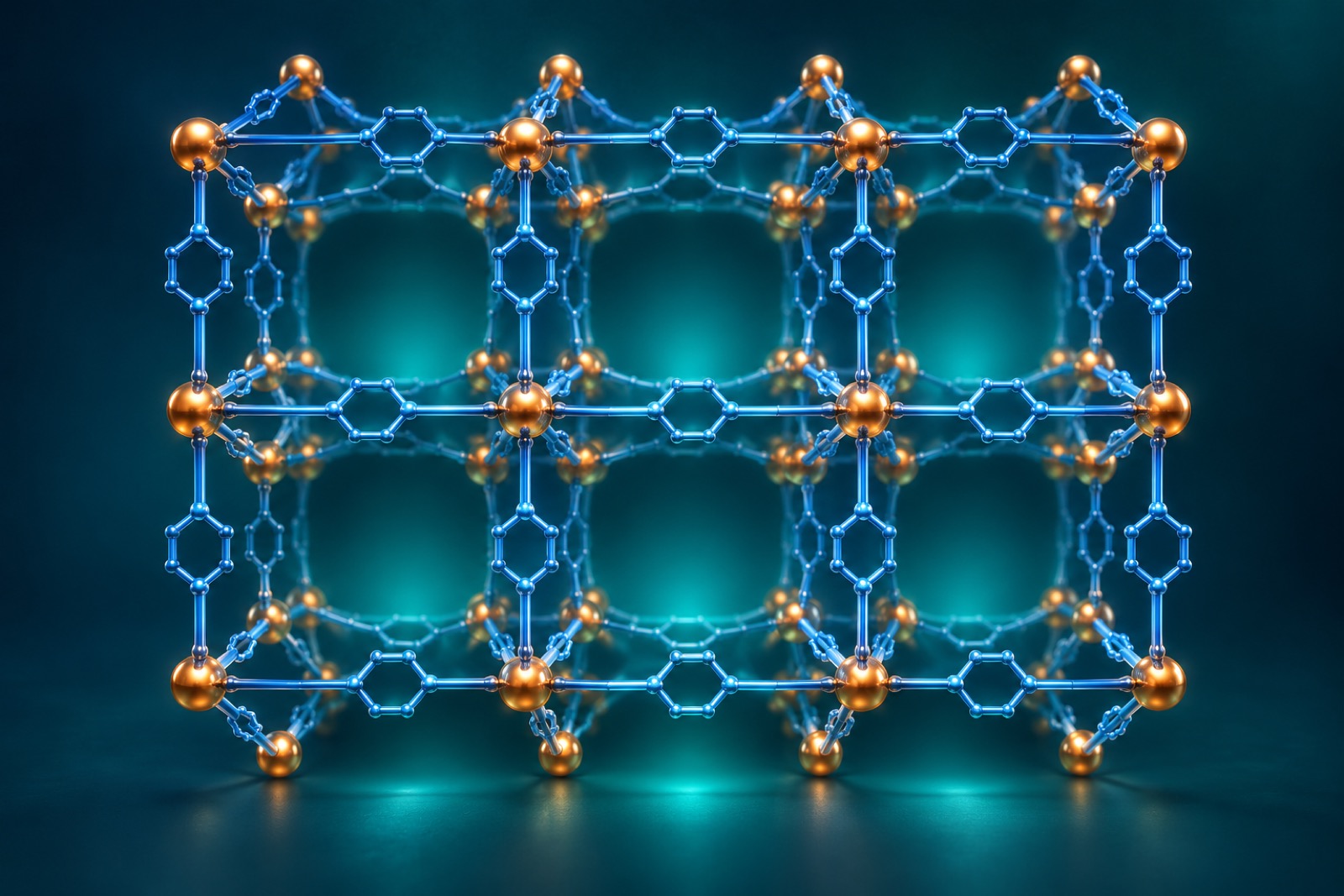
The story begins with a deliberate change in attitude. In 1989, Richard Robson combined positively charged copper ions with a four-armed organic molecule whose ends were attracted to copper. The parts locked into a spacious, ordered crystal, almost like a diamond riddled with cavities. The construction showed what was possible, yet it was fragile. Potential alone was not enough. A useful framework had to keep its shape after the solvent left the pores, and it had to survive handling long enough for gases to enter and exit without collapse.
Through the 1990s and early 2000s, Kitagawa and Yaghi, working separately, turned the fragile idea into a durable method. Kitagawa showed that gases could move in and out of such frameworks and argued that the materials need not be rigid bricks. Some could flex, open, and respond. Yaghi produced highly stable frameworks and demonstrated that their properties could be changed by rational design rather than by lucky accident. A landmark example is MOF-5, built from zinc clusters linked by terephthalate units, which helped establish that permanent porosity and high internal surface area could be engineered into an organic-inorganic crystal.
What makes the approach powerful is the logic behind it. Reticular chemistry, as Yaghi and colleagues describe it, is the practice of linking molecular building blocks into predetermined extended structures held by strong bonds. The metal nodes set geometry and often provide binding sites. The organic linkers set distance, stiffness, and chemical character. Change the metal, change the linker length, change a functional group on the linker wall, and the pore size, surface chemistry, and selectivity change with it. Chemists are no longer limited to discovering a porous solid and then asking what it might do. They can reverse the order: decide what molecules should enter, then design the room.
That design freedom shows up in surface area. Inside a well-made MOF, the internal walls can offer hundreds or even thousands of square meters of surface for every gram of solid. Guests do not sit on the outside of a powder grain alone. They thread into a three-dimensional interior. Hydrogen, methane, carbon dioxide, water vapor, and many other species can adsorb on those walls, condense in narrow spaces, or pass selectively through windows between cages. The framework becomes both container and filter.
Applications follow from that dual role. Gas storage is an obvious use: a tank filled with a high-capacity MOF can increase usable capacity at a given pressure, or help store the same amount at a lower pressure, depending on the material and system design. Separations are another: pores and wall chemistry can favor one molecule over another, supporting cleaner industrial streams or more selective capture. Catalysis can take place when open metal sites or installed catalytic groups turn the cavities into tiny reactors. Sensing becomes possible when a guest changes the optical, electrical, or mechanical response of the lattice. The Nobel Committee highlighted water harvesting from dry air, capture of specific gases, storage of hazardous chemicals, and chemical reactions inside the frameworks.
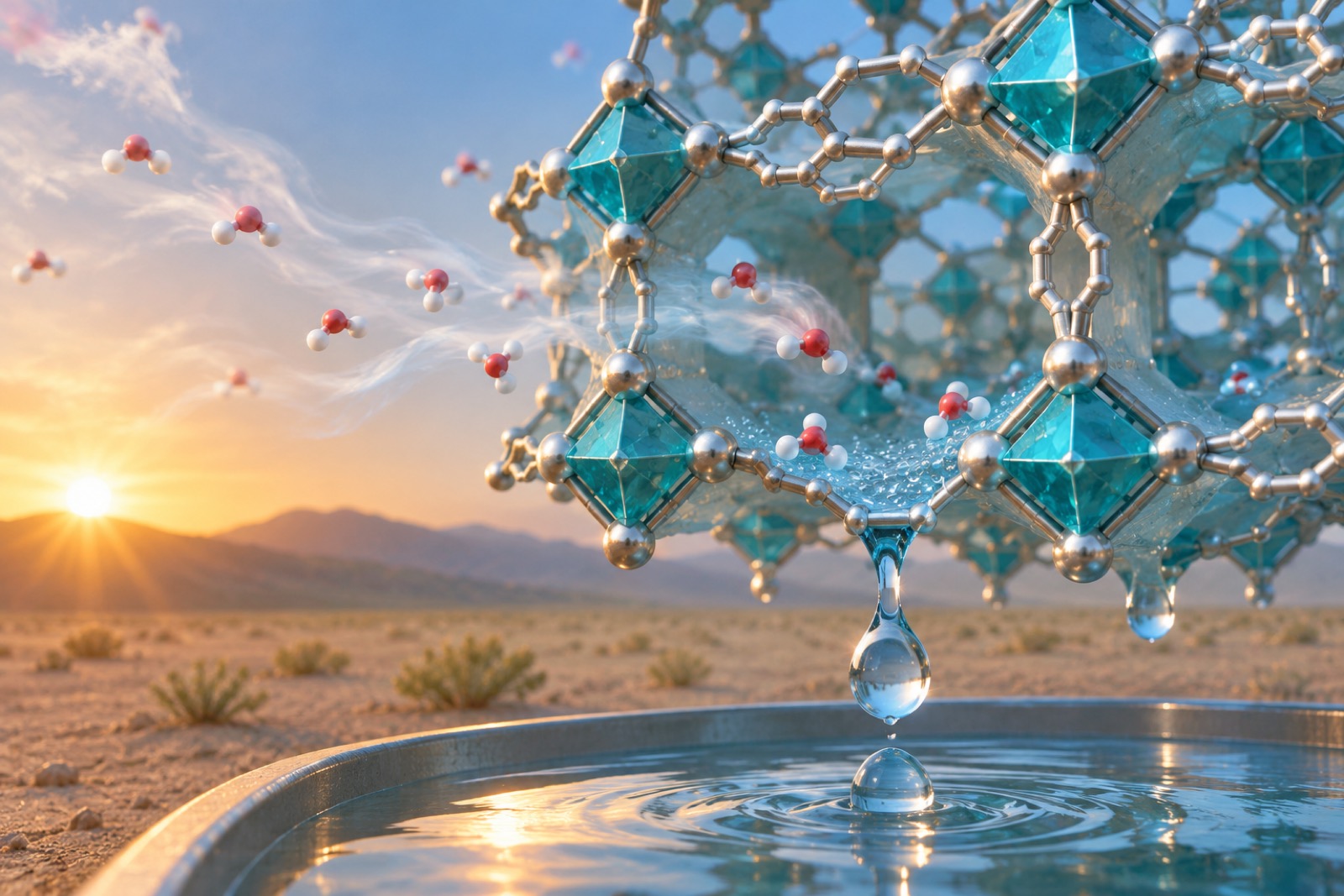
Water harvesting illustrates the chemistry with unusual clarity. A carefully chosen MOF can take up water vapor even when the surrounding air is dry. When the temperature rises a little, often with mild heat from sunlight or waste heat, the framework can release the water for collection in a designed device. The cycle is adsorption chemistry made practical: affinity strong enough to pull vapor from air, but not so strong that regeneration becomes expensive. Research groups have continued to tune linkers and pore environments to raise capacity and speed. The result is not magic. It is a materials problem stated in thermodynamic and kinetic language, then answered with a crystal whose interior chemistry matches the job.
None of this erases the hard constraints. Early MOFs often failed in water or under acid. Moisture can attack metal-linker bonds, rearrange the structure, or fill pores so thoroughly that capacity and rate collapse. Industrial users also need bulk powder that remains crystalline after scale-up, shaping, pelletizing, and repeated cycling. Organic linkers can be costly. Mass transport through a large particle can lag behind the intrinsic capacity of the crystal. Toxicity, metal leaching, dust handling, and end-of-life recovery matter as soon as a laboratory success leaves the glovebox. A beautiful structure that cannot survive steam, contaminants, or mechanical stress is still only a beautiful structure.
Stability work has therefore become central rather than secondary. Chemists select harder metal-linker pairs, introduce protective functional groups, coat particles, embed frameworks in composites, and study defect chemistry with the same seriousness once reserved for structure determination. Computational modeling now screens candidate nodes and linkers before a flask is heated. High-throughput experiments test many compositions quickly. The field has moved from proof that porous hybrid crystals exist to a continuous argument about which designs survive real process conditions.
Related families extend the same idea. Zeolitic imidazolate frameworks borrow geometry from zeolite nets while using imidazolate linkers. Covalent organic frameworks replace metal nodes with strong covalent organic connections, offering light frameworks with their own design rules. Molecular weaving and other advanced reticular constructions push control still further. The shared theme is deliberate connectivity: strong bonds, repeating units, and open space that remains after synthesis solvents are removed.
It is worth separating promise from product. Tens of thousands of MOFs have been reported. Only a smaller set has been produced at meaningful scale, formulated into beads or films, and tested through long duty cycles. Company and academic claims about capacity should always be read beside independent measurements, humidity conditions, regeneration energy, and lifetime data. The honest standard is not whether a framework can do something remarkable once. It is whether it can do it repeatedly, safely, and at a cost that fits the application.
Even with those caveats, the conceptual leap is large. For much of materials history, porosity was something a solid either had or did not have. Reticular chemistry treats porosity as a designed variable. The unit cell becomes a program. The cavity becomes a workplace. The wall becomes a chemical surface that can be edited. That shift joins synthetic organic chemistry, inorganic coordination chemistry, crystallography, and process engineering in one object.
There is also a cultural lesson for researchers watching from outside the field. Robson's early crystal was unstable. Kitagawa's insight about gas flow and flexibility required patience with dynamic solids. Yaghi's stable, programmable frameworks required refusing the idea that hybrid materials must remain fragile curiosities. Progress came from treating failure modes as design specifications. Collapse, hydrolysis, and blocked pores were not reasons to abandon the architecture. They were reasons to strengthen the joints, change the metal, lengthen or stiffen the linker, and measure again.
For scientists and engineers working today, metal-organic frameworks offer a concrete invitation. Start with the molecule that must be stored, separated, catalyzed, or detected. Ask what pore size, wall polarity, open metal site, and mechanical robustness that molecule demands. Then build the room to match, rather than forcing the molecule to fit whatever solid is already on the shelf. The 2025 Nobel Prize recognizes a method as much as a class of solids: the method of assembling emptiness with intention.
That method still has unfinished work. Scale-up, durability, recycling, and honest process metrics will decide which frameworks leave the journal page. Yet the core idea already changes how materials research can be practiced. Creativity here is not only inventing a new formula. It is arranging known chemical affinities into a lattice that performs a job no dense crystal can perform. Persistence is the willingness to rebuild the same architecture until water, heat, and time stop destroying it. Unconventional thinking is the decision that empty space inside a crystal is not wasted space, but the most valuable product of the synthesis.
Metal-organic frameworks show that chemistry can design the places where chemistry happens. When researchers accept that challenge, they stop waiting for nature to hand them a useful pore. They draw the pore, choose the walls, and invite the right molecules inside. The rooms are open. The next experiments decide what work gets done there.