
Before genes had a name, inheritance looked like a fog. Parents produced offspring that resembled them, yet traits blended, vanished, and reappeared in patterns that defied simple arithmetic. In the mid-nineteenth century, many naturalists still imagined heredity as continuous mixing, as if a child's features were a diluted average of the parents'. That picture could not explain why a trait might disappear for a generation and return later, or why some crosses yielded clean numerical ratios rather than endless intermediate shades. The clarification came not from a famous metropolitan laboratory, but from a carefully counted garden of peas tended by an Augustinian friar whose patience turned heredity into something measurable.
Gregor Johann Mendel was born on July 20, 1822, in Heinzendorf, then in Austrian Silesia and now Hynčice in the Czech Republic. He entered the Augustinian monastery in Brno in 1843, studied physics and natural sciences at the University of Vienna from 1851 to 1853, and returned to teach and experiment. The monastery garden became his laboratory. He chose the garden pea, Pisum sativum, because it offered clear alternative traits, controlled pollination, and rapid generations. Height, seed shape, seed color, flower color, and pod form were not vague impressions. They were contrasts he could score with care. That choice of material was as important as any later calculation. A confused organism would have produced a confused theory.
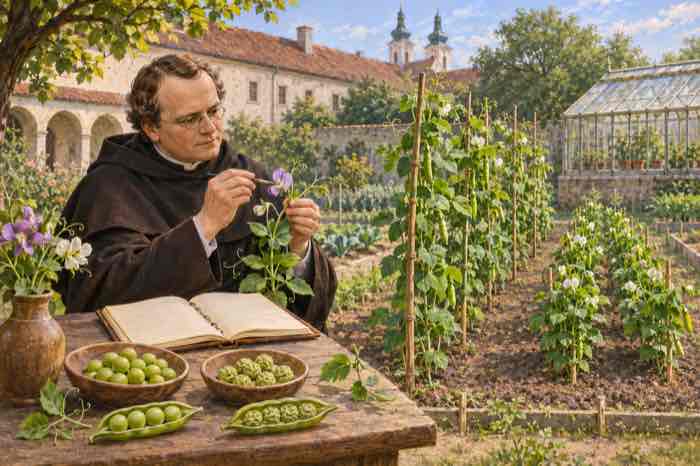
Mendel's method was deliberately austere. He began with true-breeding lines, plants that produced only one form of a trait when self-pollinated for generations. He then crossed pure tall plants with pure short ones, pure round-seeded with pure wrinkled, and so on for seven carefully chosen pairs of contrasting characters. In the first hybrid generation, one form of each trait dominated visibly. Tall crossed with short produced tall offspring. The short form seemed erased. A simple blending model would have suggested intermediate plants. Mendel saw something else: dominance, not compromise.
The second generation restored the missing form. When those hybrid tall plants self-fertilized, short plants reappeared in roughly one quarter of the progeny. Across large groups of plants, the tall-to-short ratio approached three to one. Similar ratios appeared in the other traits. The vanished character had not been destroyed. It had been carried unseen and then exposed by segregation. Mendel inferred that each plant carried a pair of hereditary factors for a given character, that offspring received one factor from each parent, and that the factors separated when reproductive cells formed. What looked like blending at the surface was discrete transmission underneath.
He went further. By tracking two traits at once, such as seed shape and seed color, he asked whether factors for different characters traveled as a package or moved independently. His dihybrid crosses produced combinations in ratios close to nine to three to three to one among the four phenotype classes. That pattern is what independent assortment predicts when two factor pairs are not linked in a way that distorts the expected proportions. Mendel did not yet know chromosomes, meiosis, or DNA. He did know that the arithmetic of his gardens demanded particulate factors that could separate and recombine.
Why did these results matter so deeply? Because they replaced a vague story of mixing with a testable mechanism. If hereditary units are discrete, variation can be preserved rather than averaged away. A rare form need not dissolve into the population mean. It can remain hidden in a hybrid and reappear when matching factors meet again. That logic later became indispensable to evolutionary biology, plant and animal breeding, and medical genetics. Natural selection needs heritable differences that do not smear into uniformity each generation. Mendel supplied the missing grammar of inheritance, even though his results were first presented in Brno in 1865 and published in the society's proceedings in 1866 with little immediate impact.
The neglect is part of the story. Charles Darwin was searching for a workable theory of heredity while Mendel's paper went largely unread. Darwin's own provisional ideas about gemmules did not provide a clear account of how variation persists. Mendel had counted what Darwin needed, yet the two programs did not meet. Around 1900, Hugo de Vries, Carl Correns, and Erich von Tschermak independently reported work that brought Mendel's ratios back into view. The rediscovery converted a local study of plant hybridization into a foundation of classical genetics.
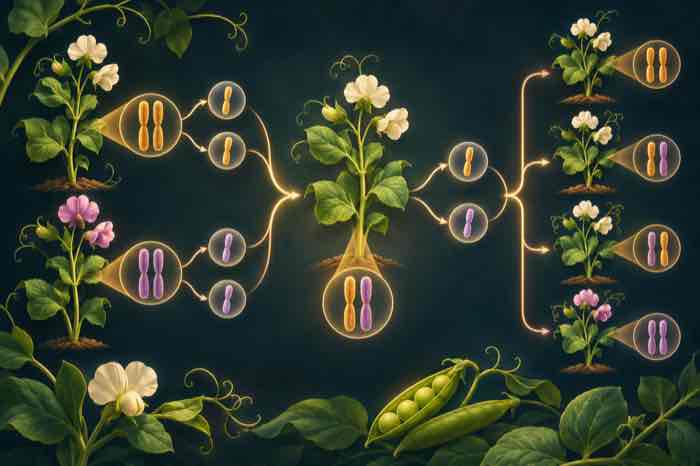
Modern genetics has complicated Mendel's picture without erasing it. Many traits are polygenic, shaped by dozens or hundreds of loci plus environment. Dominance is often incomplete. Linked genes on the same chromosome can depart from the proportions expected under independent assortment. DNA structure, gene regulation, epigenetics, and developmental networks add layers Mendel could not have imagined. Yet the core principles remain part of the elementary grammar of sexual inheritance: genes can exist in different alleles, reproductive cells carry one allele from each pair, fertilization restores pairs, and statistical ratios emerge when large numbers are scored. Every Punnett square in a classroom is a miniature version of the Brno garden.
Mendel's achievement also illustrates what careful experimental design can extract from ordinary materials. He did not possess electron microscopes or sequencing machines. He possessed controlled crosses, large sample sizes, honest counting, and the mathematical habit of looking for simple ratios beneath messy biological detail. He chose traits that behaved cleanly enough for his purpose. He was not claiming that every character in nature follows a single-gene pattern. He was isolating conditions under which the particulate nature of inheritance became visible. That is how foundational laws are often found: by simplifying until the signal can no longer hide.
There is a further lesson in the delay between discovery and recognition. Important results can sit in plain sight when they do not match the dominant vocabulary of a field. Mendel spoke the language of factors and ratios while many contemporaries still thought in fluids and essences. The data were public. The conceptual frame that made them intelligible arrived later. Researchers today face analogous gaps whenever new measurements outrun the categories available to interpret them. The remedy is not louder speculation. It is the Mendelian discipline of designing experiments that force nature to answer in countable form, then holding the answer until the wider conversation is ready to hear it.
For plant breeders, Mendelian ratios became practical tools as the work was rediscovered. Predictable segregation made it possible to recover desired combinations, maintain pure lines, and design crosses with intent rather than hope. In human genetics, the same logic clarified recessive diseases that can skip generations, dominant conditions that appear when one altered allele is sufficient, and the statistical risks that genetic counseling must communicate carefully. The pea garden's arithmetic scaled, with appropriate caution, to medicine and agriculture alike.
Mendel died on January 6, 1884, still largely unknown outside his local scientific circle. He had become abbot of the monastery in 1868, and administrative duties occupied much of his later life. He did not live to see genetics named, genes located on chromosomes, or DNA identified as the chemical bearer of the factors he had inferred. That historical irony sharpens rather than diminishes the work. He showed that a solitary investigator, armed with a clear question and rigorous counts, can reveal a structure that later centuries only deepen. The hidden architecture of inheritance was operating in every field and every family line. Mendel made it legible.
For researchers working now, the invitation is direct. Choose problems where the variables can be isolated. Prefer measurements that survive contact with large numbers. Be willing to let a simple ratio overturn a comforting narrative of continuous blending. And remember that the most consequential paper in a career may look, at first, like a local study of peas. Creativity in science is not only the leap to a new theory. It is also the stubborn decision to keep counting until nature's pattern can no longer be denied. Mendel's garden remains a standing challenge to anyone who mistakes obscurity for unimportance, or who waits for perfect instruments before asking a precise question. The factors were there. Someone had to score enough generations to see them.
Explore the evidence: