
Modern life depends on a quiet contract with chemistry. A phone must wake without a wall socket. A laptop must survive a flight. An electric car must carry kilometers of motion in a pack that does not weigh more than the vehicle itself. Behind those expectations sits a single class of devices that store electricity as ordered chemical potential and release it on demand. Lithium-ion batteries made that contract practical. They did not invent the idea of a battery. They reinvented what a battery could be: light enough to carry, strong enough to matter, and stable enough to recharge again and again.
The story begins in a period of energy anxiety rather than consumer electronics. In the 1970s, researchers looked for ways to reduce dependence on fossil fuels and to store energy more intelligently. M. Stanley Whittingham, working in that climate, explored materials that could host ions inside their crystal structure. He found that titanium disulfide could intercalate lithium ions - that is, slip them into layered spaces without destroying the host lattice. Paired with a lithium-metal anode, the arrangement produced a cell with serious voltage and a new design logic. Energy would no longer rest only on irreversible chemical reactions that chewed through electrodes. It could ride on ions moving in and out of ordered solids.
That first architecture still carried a dangerous flaw. Metallic lithium is eager to release electrons, which is useful for voltage and disastrous for safety when dendrites form and short the cell. The chemistry had potential, literally more than two volts in Whittingham's early work, but a commercial product cannot explode its way into everyday use. The engineering problem shifted. Keep the high energy of lithium chemistry. Remove the most reactive form of lithium metal from the anode. Build electrodes that can host ions repeatedly without falling apart.
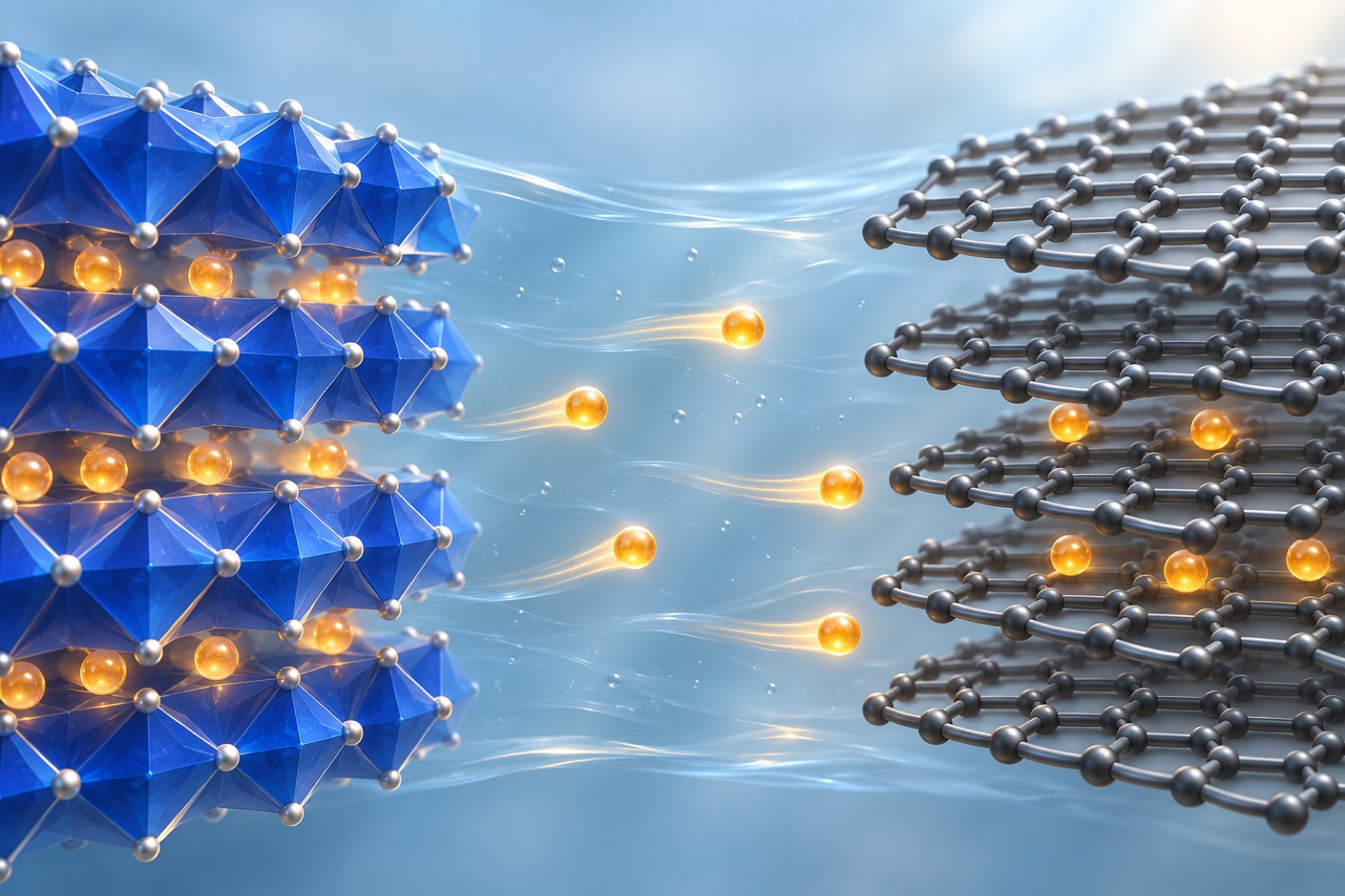
John B. Goodenough approached the cathode as a materials problem with a clear hypothesis. If a metal oxide could host lithium ions more effectively than a metal sulfide, the cell voltage should rise. In 1980 he demonstrated lithium cobalt oxide as a cathode capable of roughly four volts - a decisive step that raised the energy density of the entire concept. Higher voltage is not a vanity metric. For the same current, it means more power and more usable energy in a smaller package. Goodenough's oxide cathode turned an interesting intercalation battery into a platform that could compete with the demands of portable technology still on the horizon.
Akira Yoshino completed the commercial architecture. Instead of a metallic lithium anode, he used a carbon material - petroleum coke in the early work - that could intercalate lithium ions safely. Both electrodes would now store lithium as guests inside solid hosts. During charge, ions leave the cathode and settle into the carbon anode. During discharge, they travel back while electrons move through the external circuit and do useful work. The electrodes remain largely intact as frameworks. The mobile species is the ion. That design is why lithium-ion cells can be charged hundreds of times before performance fades enough to matter for ordinary use.
Sony brought the technology to market in 1991, and the consequences arrived faster than many infrastructure technologies ever do. Camcorders, phones, laptops, power tools, medical devices, drones, and eventually electric vehicles all found a storage medium that matched their weight and volume constraints. The Nobel Prize in Chemistry in 2019 recognized Whittingham, Goodenough, and Yoshino for this development, describing a lightweight, rechargeable, powerful battery used from handheld electronics to long-range cars and renewable energy storage. The citation was not about a single gadget. It was about a general-purpose energy component that reshaped how societies move information, people, and power.
How does the cell actually work when stripped of marketing language? A lithium-ion battery has a positive electrode (cathode), a negative electrode (anode), a separator, and an electrolyte that lets ions pass while electrons are forced through the external circuit. In many commercial chemistries the cathode is a layered metal oxide or a related structure that can release and accept lithium. The anode is often graphite. The electrolyte is typically a lithium salt dissolved in organic solvents, sometimes with additives that form protective surface films. When you charge the battery, an external power source drives lithium ions from cathode to anode. When you use the battery, those ions return while electrons power the device. The U.S. Department of Energy describes this coupled motion of electrons outside and ions inside as the basic reversible storage cycle of modern batteries.
Intercalation is the quiet hero of the design. In a crude chemical battery, electrodes can be consumed and rebuilt in ways that leave residue, change shape, and limit cycle life. In an intercalation battery, the host lattices expand and contract as guests arrive and leave, but they aim to remain the same hosts. Reality is never perfect. Surfaces crack. Electrolytes decompose. Protective films grow. Metal can plate where it should not. Still, the ideal is clear: reversible ion traffic through stable frameworks. That ideal is why engineers obsess over crystal structure, particle size, coatings, binders, and electrode porosity. A battery is a chemical system pretending to be an electrical component, and every interface has to honor both identities.
Different cathode families trade energy, power, cost, and safety. Lithium cobalt oxide helped launch consumer electronics but raises cost and ethical supply concerns around cobalt. Nickel-rich layered oxides push energy density for electric vehicles. Iron phosphate chemistries often trade some energy density for improved thermal stability and lower cost. Spinels and other structures appear where power or specific constraints matter. Anodes are changing too. Silicon can store far more lithium than graphite in principle, but it swells dramatically and can pulverize. Engineers therefore blend silicon carefully, design binders that survive expansion, and accept that the perfect anode on paper can fail in a packed electrode. There is no single winning recipe. There is a map of compromises matched to the job.
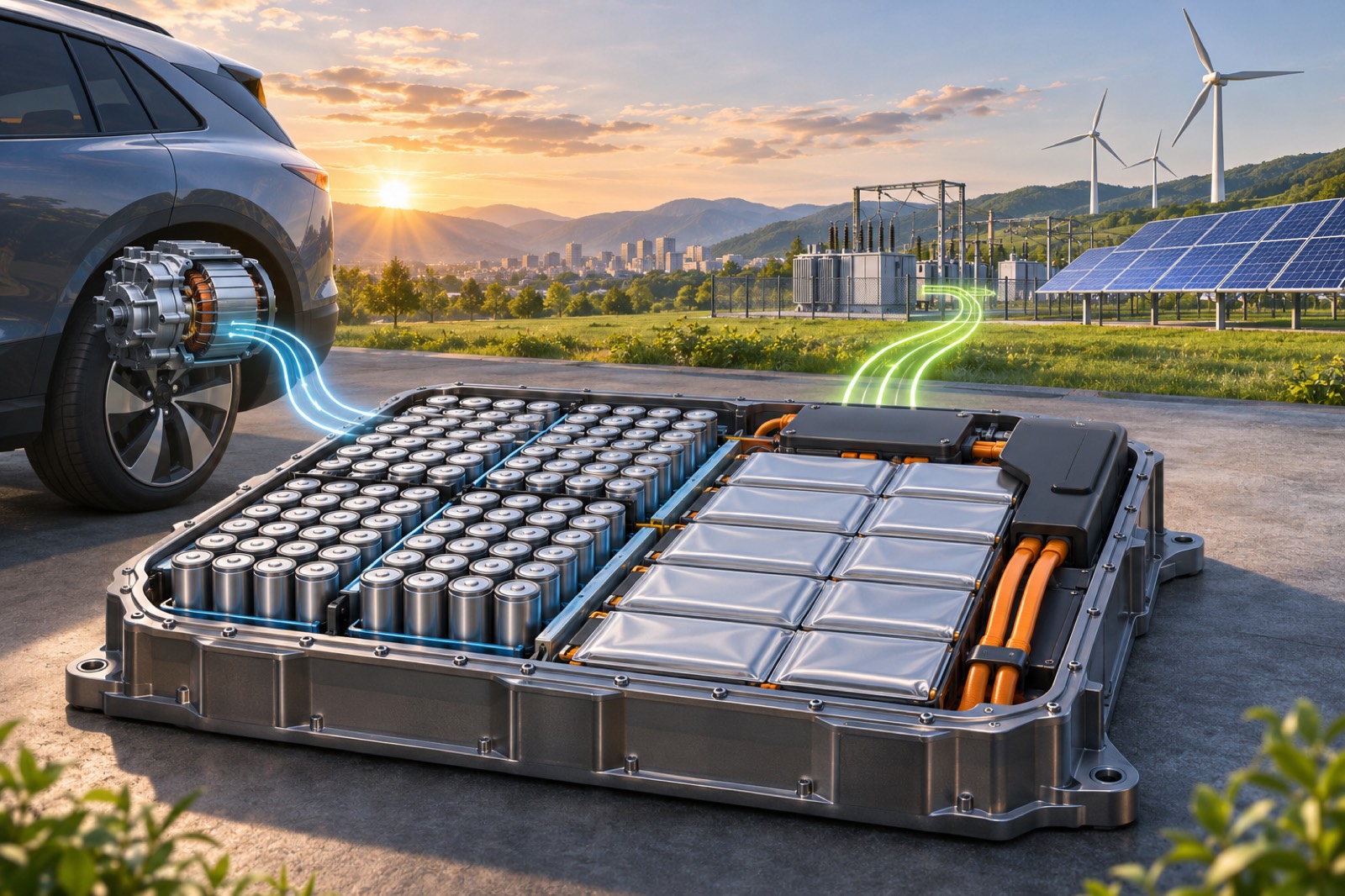
Safety is not a side note. Organic electrolytes can burn. Thermal runaway can cascade through a pack. Mechanical damage, overcharge, internal shorts, and poor thermal design all raise risk. Modern packs answer with battery management systems that watch voltage, current, and temperature cell by cell; with separators designed to shut down ion flow if heat rises; with mechanical structures that contain failure; and with chemistries chosen for the operating envelope. The public story of a battery is often capacity in watt-hours. The engineering story is how the pack behaves on the worst day, not the brochure day.
Manufacturing turns laboratory electrochemistry into industrial reliability. Electrode slurries must coat evenly across kilometers of foil. Calendering sets density. Drying removes solvents without wrecking microstructure. Cells are wound or stacked, filled, formed, graded, and assembled into modules and packs. Tiny defects become large failures at scale. That is why battery factories look more like precision process plants than simple assembly lines. Energy density headlines matter, but yield, consistency, and lifetime under real duty cycles decide whether a chemistry becomes a product.
The same cells that freed phones from the wall are now asked to free grids from the timing of the sun and wind. Stationary storage does not need the same weight targets as a phone, yet it still needs cycle life, fire safety, round-trip efficiency, and predictable degradation over years. Electric vehicles demand high energy per kilogram, fast charging without destroying the anode, cold-weather performance, and recycling pathways that recover valuable metals. Aviation and heavy transport raise the bar further. Each application is a different optimization problem wearing the same family name.
Limits remain honest and important. Lithium-ion cells still store far less energy per kilogram than liquid hydrocarbon fuels, which is why long-haul aviation and some heavy equipment remain hard to electrify with packs alone. Charging infrastructure, mineral supply chains, refining, and end-of-life recovery are part of the technology, not external politics pasted on afterward. Cobalt, nickel, lithium, and graphite each carry geological and social constraints. Responsible engineering treats those constraints as design inputs: less critical metal per kilowatt-hour, longer life so fewer packs are made, second-life uses, and recycling that actually closes loops.
Research continues because the first commercial success was a beginning, not a finish line. Solid-state electrolytes promise different safety and energy tradeoffs if interfaces can be mastered. Lithium-metal anodes still tempt designers with higher capacity if dendrites can be controlled. Sodium-ion and other chemistries explore earth-abundant alternatives for applications where ultimate energy density matters less than cost and supply. Advanced diagnostics, machine learning on formation data, and better models of degradation aim to shorten the distance between a new material and a trustworthy cell. Progress is rarely a single breakthrough announcement. It is usually a stack of improvements that survive independent testing.
What makes the lithium-ion story durable is its method. Whittingham showed that intercalation could store energy in ordered solids. Goodenough raised the voltage by choosing a better host. Yoshino removed the most dangerous anode design and made a cycleable commercial cell. Industry then spent decades turning that architecture into packs that people trust in their pockets and under their floors. The sequence is a model for deep technology: fundamental materials insight, voltage and safety engineering, then manufacturing discipline.
For researchers and builders working on energy storage today, the lesson is practical and demanding. Do not confuse a high laboratory capacity with a finished device. Measure what happens after hundreds of cycles, after heat, after cold, after imperfect charging. Treat every interface - particle surface, binder, separator, current collector, pack busbar - as part of the invention. Ask whether the next gain requires a brand-new chemistry or a wiser arrangement of known pieces. Lithium-ion batteries succeeded because they turned a reactive element into a controlled shuttle inside solid hosts. That control is the real product.
The broader invitation is larger than any single phone or car. A society that can store electricity cleanly can use intermittent renewable generation more fully, move people with fewer local emissions, and design tools that do not chain users to a socket. Those outcomes are not automatic. They depend on safer packs, fairer supply chains, honest performance claims, and engineers willing to improve unglamorous details. The rechargeable world was not discovered fully formed. It was assembled, ion by ion, by people who treated materials as instruments rather than mysteries. That is still the work in front of us.