
Electric power is so ordinary that it barely registers as a scientific achievement. Lights switch on, motors spin, and grids move energy across continents as if those abilities had always been part of the furniture of the world. They have not. For most of human history, magnetism and electricity were separate curiosities: lodestones that pointed north, sparks that jumped from amber, and batteries that could make a frog's leg twitch. The hinge that joined those domains into a single, usable force was electromagnetic induction - the discovery that a changing magnetic field can drive an electric current. In 1831, working with coils, iron, and relentless notebook discipline at the Royal Institution in London, Michael Faraday made that hinge real.
The intellectual landscape Faraday entered was already electric in the literal sense. Alessandro Volta's pile had given experimenters a steady source of current. Hans Christian Ørsted had shown in 1820 that a current-carrying wire deflects a compass needle, proving that electricity produces magnetism. André-Marie Ampère and others quickly built a mathematical language for the forces between currents. Yet the reverse link remained stubborn. If electricity could make magnetism, could magnetism make electricity? Many tried. Most expected a steady magnet near a wire to produce a steady current the way a battery does. Nature refused that simple symmetry. Faraday's contribution was not only to find the missing effect, but to recognize that the decisive ingredient was change in time.
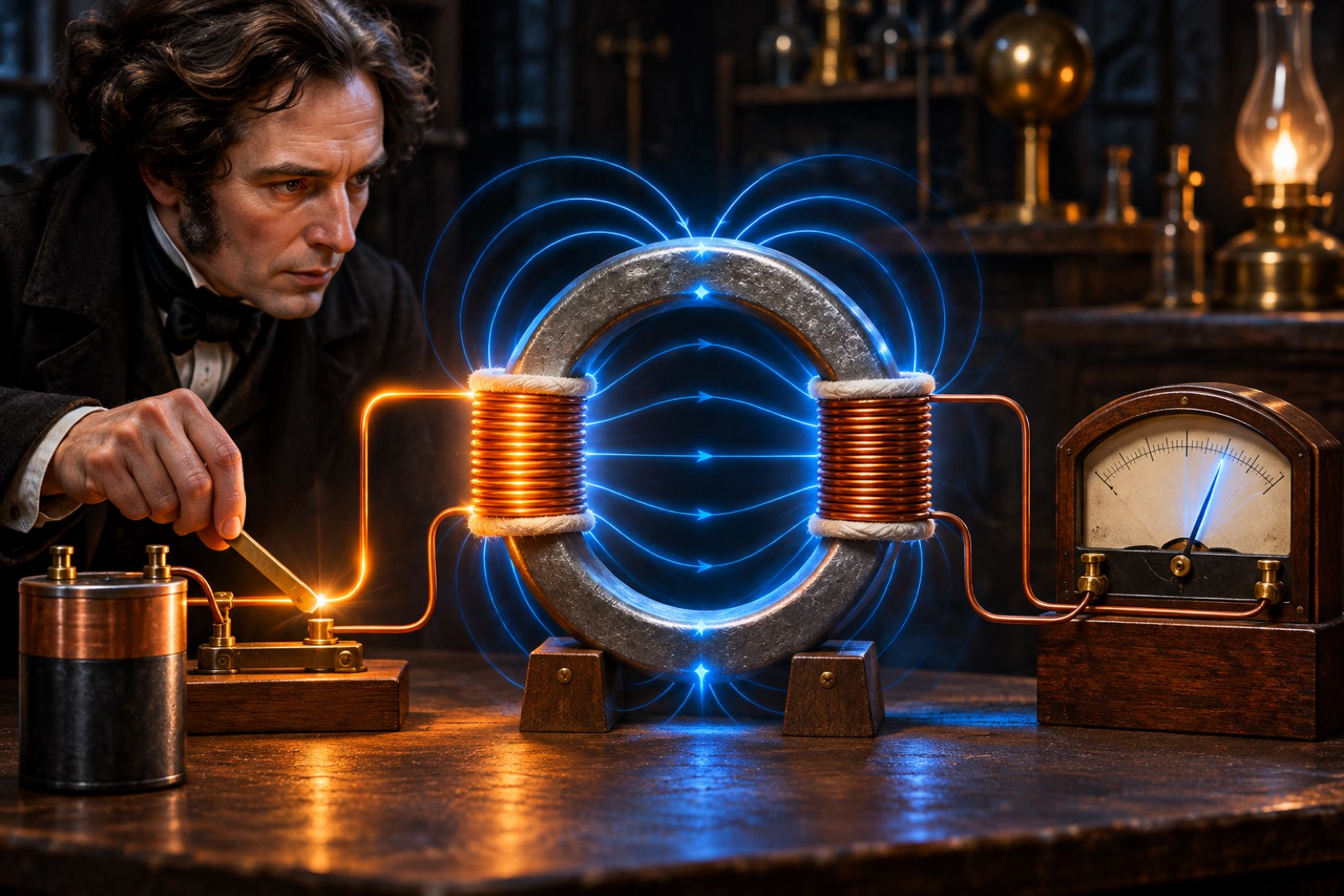
On 29 August 1831 Faraday wound two separate coils of insulated wire around opposite halves of a soft iron ring. One coil he connected to a battery; the other he connected to a galvanometer, a sensitive detector of current. The coils shared no electrical connection. When he closed the battery circuit, the galvanometer needle kicked. When he opened it, the needle kicked the other way. While the battery current ran steadily, the needle sat still. The induced current appeared only during the brief intervals when the magnetic state of the iron was changing. Faraday had produced electricity from magnetism without any sliding contacts or chemical action in the detector circuit. The iron ring was a transformer in embryo.
He pressed the insight through a sequence of variations that turned a lucky observation into a law of nature. A bar magnet thrust into a hollow coil produced a pulse of current; withdrawing it produced a pulse of opposite sign. Rotating a copper disk between the poles of a magnet and taking leads from the axis and the rim yielded a continuous current - the Faraday disk, an early dynamo. Moving a wire across a magnetic field induced an electromotive force along the wire. Across these arrangements a single pattern emerged: whenever the magnetic influence linked with a circuit changed, an electromotive force appeared. Steady magnetism was not enough. Motion, switching, or any other process that altered the linkage was required.
Faraday described the situation with lines of magnetic force, a visual language he trusted more than formal equations. He pictured space filled with tension and direction, and he treated the number of those lines threading a circuit as the quantity whose change drove induction. Later theorists would translate that picture into the language of magnetic flux. In modern terms, the electromotive force around a closed loop equals the negative rate of change of magnetic flux through any surface bounded by the loop - Faraday's law as it appears in Maxwell's equations. James Clerk Maxwell would later show that the same family of ideas, completed with the displacement current, implies electromagnetic waves traveling at the speed of light. Faraday did not write those equations. He supplied the experimental skeleton and the field intuition that made them possible.
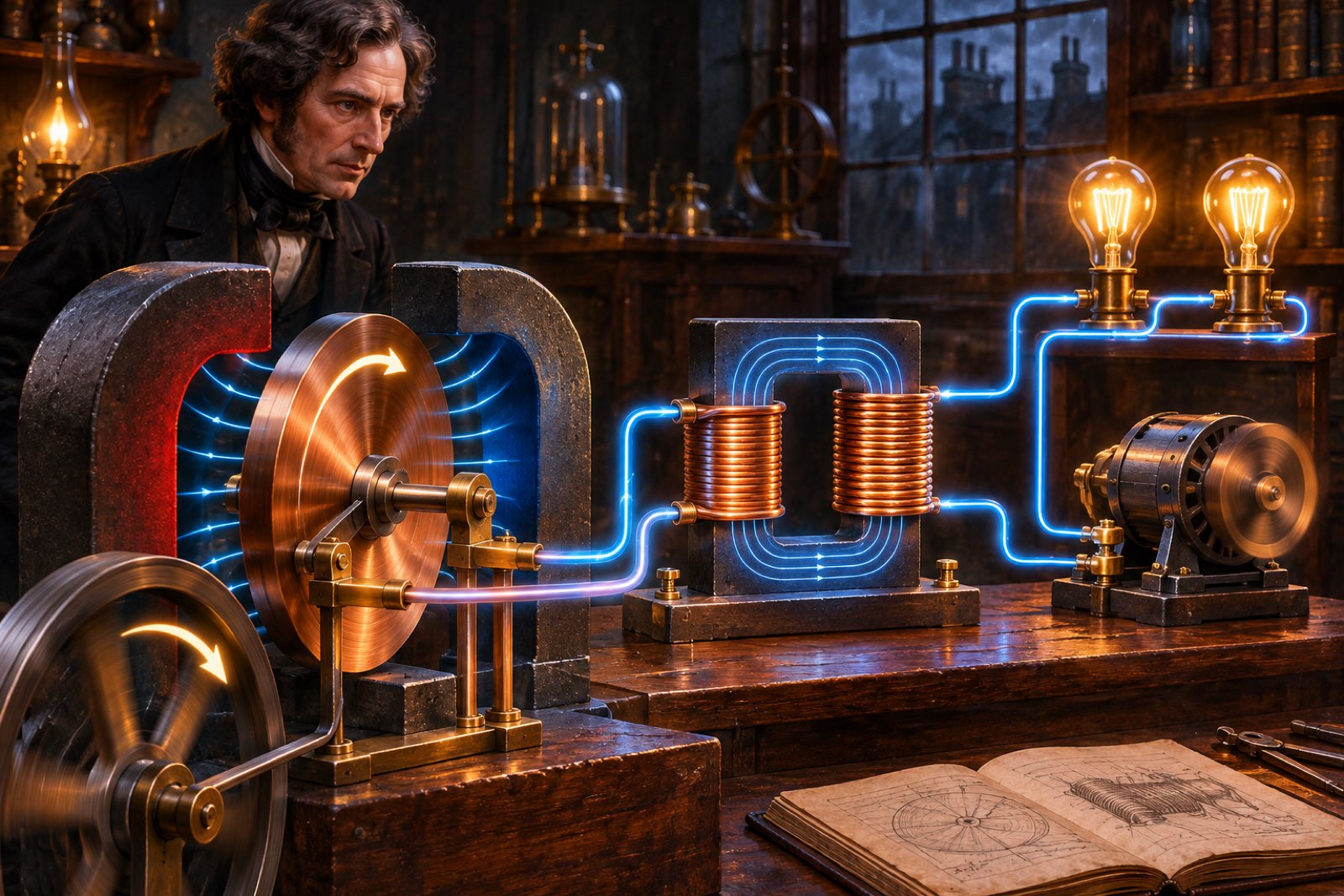
The practical consequences arrived faster than Faraday himself could fully exploit them. Once induction was understood, engineers could convert mechanical motion into electrical current with rotating armatures in magnetic fields, and they could step voltages up and down with paired coils on shared magnetic cores. Power stations, long-distance transmission, electric railways, and the household plug all rest on that conversion chain. Wireless communication later depended on oscillating currents and changing fields of the same family. Induction is not a museum curiosity adjacent to modern life. It is the operating principle inside the transformers on utility poles and the generators behind the bulk of global electricity production.
Faraday's path to that result was as important as the result itself. He had little formal mathematical training. He entered science as a bookbinder's apprentice who educated himself from the volumes he bound, then as a laboratory assistant to Humphry Davy. He kept meticulous diaries, repeated measurements, and refused to let a suggestive kick of a needle stand without systematic variation. He also refused to stop at a single apparatus. By moving from the iron ring to magnets in coils to rotating disks, he showed that induction was a general feature of electromagnetic interaction rather than a quirk of one geometry. That habit - treat an anomaly as a program of experiments rather than a one-off marvel - is what turns a laboratory surprise into a foundation for industry.
There were limits and open questions, and Faraday knew it. His qualitative field picture needed the later mathematical structure of Maxwell, Heaviside, and others before it could become a predictive engineering toolkit with the precision modern grids demand. Lenz's law clarified the direction of induced currents through energy conservation: induced effects oppose the change that produces them. The full relativistic unity of electricity and magnetism would wait for the twentieth century. Faraday also worked in a culture that sometimes undervalued a researcher without elite mathematical credentials. The durability of his results is a reminder that careful experiment can outrun the social ranking of the experimenter.
What remains sharp for today's researchers is the discipline Faraday brought to an incomplete symmetry. The community already knew that currents make magnetic fields. The reverse looked absent until someone asked whether the missing piece was not magnitude but time dependence. Many scientific dead ends are of that kind: the effect is real, but the search is aimed at the wrong invariant. Looking for a static magnetic battery was the wrong question. Looking for what happens when magnetic conditions change was the right one. Creativity here was not wild speculation. It was the patience to redesign the experiment until nature could answer the question that theory had almost, but not quite, posed.
Induction also models the coupling between pure insight and infrastructure. Faraday's notebooks did not contain business plans for continental grids. They contained coils, iron, and honest records of needles that moved only at the right moments. Yet without that laboratory integrity, the later engineering cascade would have had nothing solid to build on. Researchers who treat fundamental work as remote from application miss the historical pattern. The applications arrive when someone first forces a clean statement of how nature behaves, even if the statement is framed in lines of force rather than in finished formalism.
The lesson worth carrying forward is therefore double. First, treat incomplete symmetries as invitations. If one process produces another, ask under what conditions the reverse appears, and do not assume the conditions are the obvious static ones. Second, let apparatus teach theory. Faraday's iron ring did not merely confirm a prior equation; it taught the community what kind of equation would eventually be needed. In an age of large collaborations and heavy simulation, that laboratory humility still matters. The next foundational effect may again show itself first as a transient kick on a sensitive instrument, visible only to someone willing to change the setup, watch the moment of change, and follow the signal wherever the notebooks lead. Electromagnetic induction began as such a kick. It ended by remaking the material conditions of modern life - a reminder that careful attention to nature's timing can move more than a galvanometer needle. It can move an entire civilization's power.